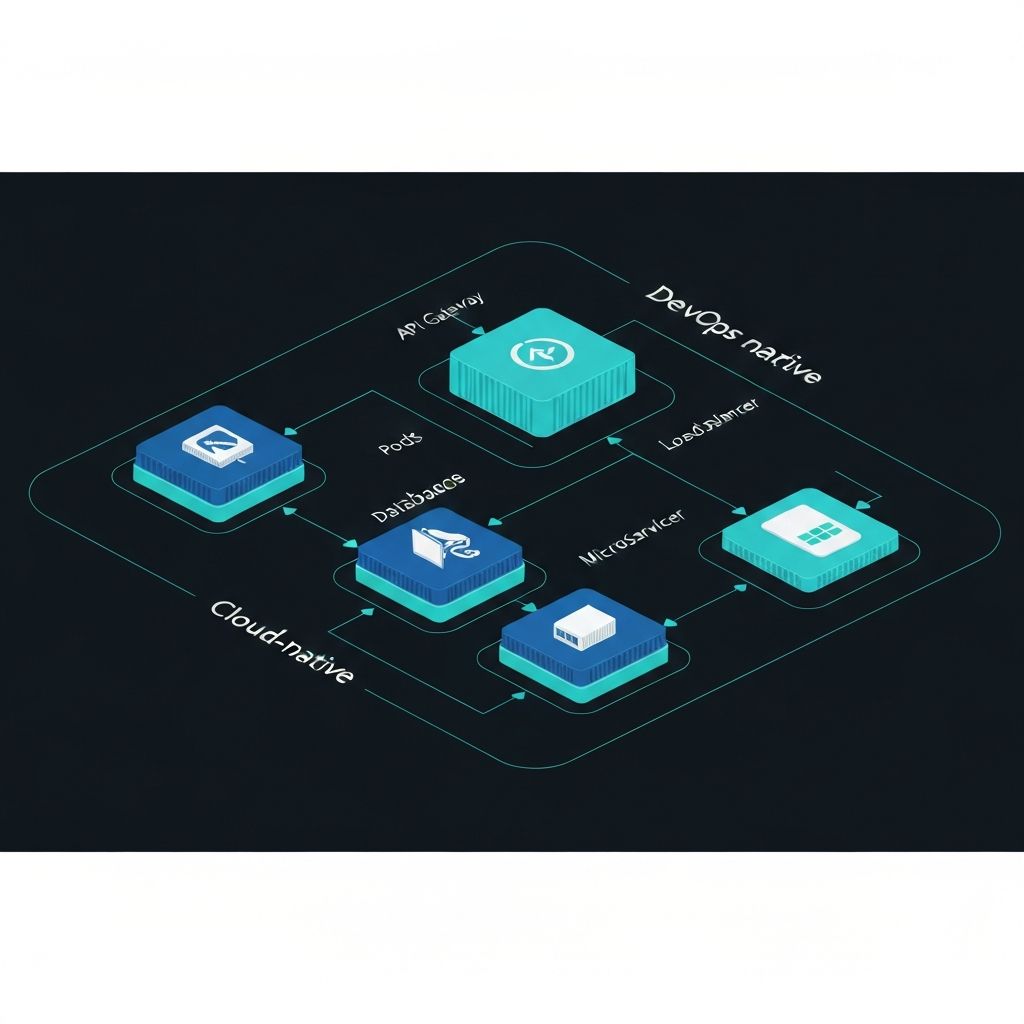
Cloud-native architecture represents a fundamental shift in how we design, build, and operate software applications. It's not just about running applications in the cloud—it's about fully leveraging cloud capabilities to build systems that are resilient, scalable, and manageable. At Inkorve, cloud-native principles inform every solution we build, and this guide shares our approach and learnings.
What Makes an Application Cloud-Native?
Cloud-native applications share several characteristics:
- Containerized: Applications are packaged as containers for consistency across environments
- Dynamically Orchestrated: Containers are actively scheduled and managed to optimize resource utilization
- Microservices-Oriented: Applications are composed of loosely coupled services that can be developed and scaled independently
- Automated: CI/CD pipelines enable rapid, reliable deployment
- Observable: Comprehensive monitoring, logging, and tracing provide visibility into system behavior
Core Architectural Patterns
Microservices Architecture
Microservices decompose applications into small, independent services, each responsible for a specific business capability. Benefits include:
- Independent deployment and scaling
- Technology flexibility per service
- Fault isolation
- Team autonomy
However, microservices introduce complexity in areas like service communication, data consistency, and operational overhead. They're not appropriate for every application—we often recommend starting with a modular monolith and extracting services as needs become clear.
API Gateway Pattern
An API gateway serves as the single entry point for client requests, handling concerns like:
- Request routing
- Authentication and authorization
- Rate limiting
- Request/response transformation
- API versioning
Service Mesh
A service mesh provides infrastructure-level capabilities for service-to-service communication:
- Traffic management
- Security (mTLS)
- Observability
- Resilience (retries, circuit breaking)
Tools like Istio and Linkerd implement service mesh patterns, though they add operational complexity that may not be justified for smaller deployments.
Event-Driven Architecture
Asynchronous, event-driven communication patterns improve resilience and scalability:
- Event Sourcing: Store state as a sequence of events
- CQRS: Separate read and write models for optimized performance
- Pub/Sub: Decouple services through message brokers
Container Orchestration with Kubernetes
Kubernetes has become the de facto standard for container orchestration. Key concepts include:
Pods
The smallest deployable units, containing one or more containers that share storage and network resources.
Services
Abstractions that define a logical set of Pods and a policy for accessing them, enabling service discovery and load balancing.
Deployments
Declarative updates for Pods and ReplicaSets, enabling rolling updates and rollbacks.
ConfigMaps and Secrets
Mechanisms for managing configuration and sensitive data separately from container images.
Ingress
Manages external access to services, typically HTTP, providing load balancing, SSL termination, and name-based virtual hosting.
Data Management Strategies
Data management in cloud-native applications requires careful consideration:
Database per Service
Each microservice owns its data, preventing tight coupling. This pattern requires careful handling of cross-service queries and transactions.
Managed Database Services
Cloud providers offer managed databases (RDS, Cloud SQL, Azure SQL) that handle operational concerns like backups, patching, and scaling.
Distributed Caching
Services like Redis or Memcached provide high-performance caching across the application, crucial for performance at scale.
Observability Stack
Cloud-native applications require comprehensive observability:
Logging
Centralized logging (ELK Stack, Splunk, cloud-native options) aggregates logs from all services for analysis and troubleshooting.
Metrics
Prometheus has emerged as the standard for metrics collection in Kubernetes environments, often paired with Grafana for visualization.
Tracing
Distributed tracing (Jaeger, Zipkin, cloud-native options) tracks requests across service boundaries, essential for debugging distributed systems.
CI/CD for Cloud-Native
Continuous integration and deployment are essential for realizing cloud-native benefits:
- GitOps: Infrastructure and application state defined in Git, with automated reconciliation
- Progressive Delivery: Canary deployments, blue-green deployments, feature flags
- Pipeline as Code: CI/CD pipelines defined in version control alongside application code
Security Considerations
Cloud-native security requires a shift-left approach:
- Container Image Scanning: Scan images for vulnerabilities before deployment
- Network Policies: Define what traffic is allowed between services
- Pod Security Standards: Enforce security best practices at the Pod level
- Secret Management: Use tools like HashiCorp Vault or cloud-native secret managers
Conclusion
Cloud-native architecture is a journey, not a destination. Start with the patterns and practices that address your most pressing needs, and evolve your architecture as your requirements and team capabilities grow. The goal is not to implement every cloud-native pattern but to leverage the right ones to build systems that serve your business effectively.